

El-Kadada
1976-1986
Directed by Francis Geus.
Team : Jacques Reinold, Patrice Lenoble, Yves Lecointe, Pascal Ginailhac, Daniel Connoioux, René Pierre Dissaux, Pierre Vandeplanque, Denis Piponnier, Annick Duflos, Paul Koren, Max Schvoerer, Claude Ney, Anne Rouannet, Florence Thill, Paul De Paepe, Sid Ahmed Kamier, Mohamed Hassan Basha, Khalil Mohamed Khalil, Salah Omer es Sadiq, Khider Adam Eisa, Damri Mohamed Abdel Latif, Amum Tor Akayding, Salah Mohamed Ahmed, Gamal el Din Mohamed Idriss.
Discovered in 1976, El-Kadada is one of the few Neolithic funerary sites known in the Shendi region.
The earliest signs of occupation are fragments of ceramic vases. Their wavy-line patterns indicate it was populated during the Khartoum Mesolithic, even though no other site from this period has been discovered in the region. The following transitional period is attested by dotted wavy line fragments identified on a small habitat in the place-name El-Kudra, located less than 200 meters from there. There is however no sign of occupation dating from the Khartoum Neolithic (fifth millennium BC). Prehistoric settlements of this period seem to have moved towards the site of El-Ghaba, 700 meters further south. The decoration of the ceramic material found in the tombs of El-Ghaba is similar to the one from the Neolithic Khartoum site, Shaheinab. The discovery of the Neolithic tombs of El-Kadada confirmed the suggestion of the British archaeologist A.J. Arkell, who first defined the terms Khartoum Mesolithic and Neolithic, of a late prehistoric period. The Neolithic populations of El-Kadada have developed an elaborated culture which is reflected in the refinement and new shapes of the ceramic decorations, the fine stone implements as well as the richness of the funerary deposit.
El-Kadada also possesses many historical cemeteries from the Napatan period to the post-Meroitic, from the eighth century BC to the sixth century AD. The funerary material of the pre-Christian graves shows that Meroitic funerary religion doesn’t end with the “end of Meroe” but with the beginning of Christianization, during the 6th century AD.
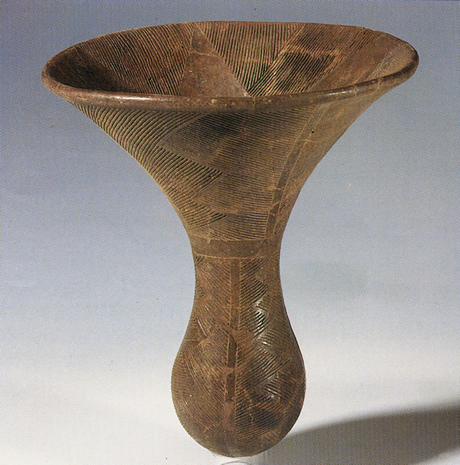
- Caliciform vase. Ceramic.
- Height 27,7 cm, max. diam. 23,4 cm, min. diam. 5,4 cm.
El-Kadada. Neolithic.
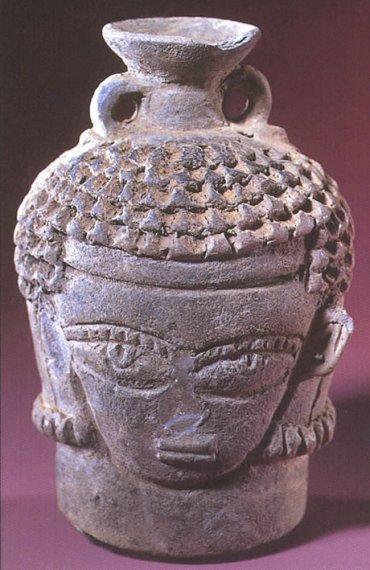
- Small perfume container used for funeral anointing.
- SNM 25680 and 26466.
Ceramic.
El-Kadada. Meroitic period.
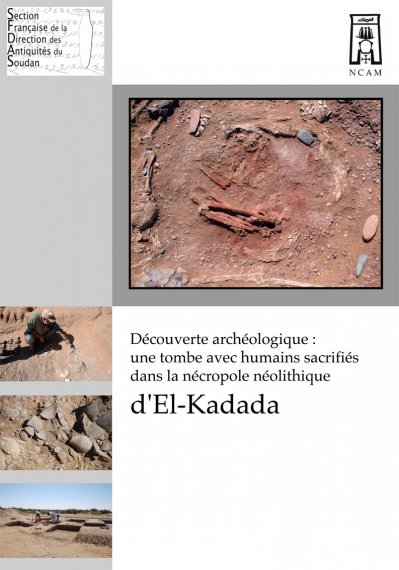
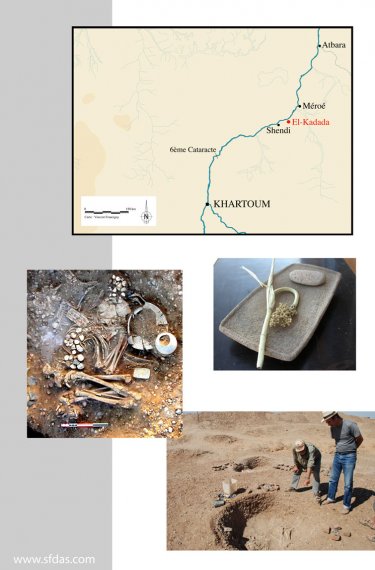

- Archaeologist Jacques Reinold with the press.

- Salah Eldin Mohamed Ahmed, excavation director at NCAM.
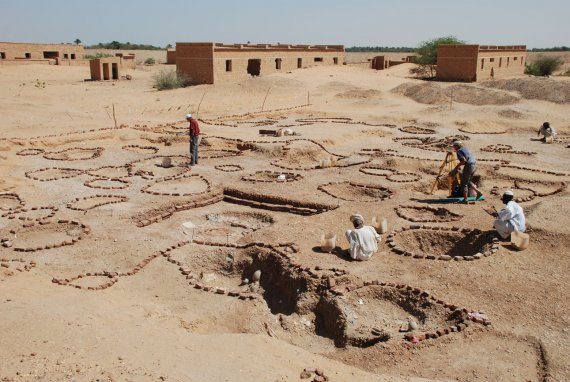
- The excavation site.

- In front of the main tomb of the necropolis.

- Neolithic ceramics from the site.
bibliography :
P. Lenoble, « Enterrer les flèches, enterrer l’Empire. II, Les archers d’el-Kadada et l’administration de l’imperium méroïtique », CRIPEL 20, 1999, pp. 125-144.
J. Reinold, « Les fouilles françaises et franco-soudanaises : el-Kadada », dans Nubie. Les cultures antiques du Soudan (B. Gratien et F. Le Saout éd.), Lille, 1994, p. 51-66.
P. Lenoble, « Trois tombes de la région de Méroé : la clôture des fouilles historiques d’el-Kadada en 1985 et 1986 », Archéologie du Nil moyen 2, 1987, p. 89-119.
J. Reinold, « Le nécropole néolithique d’el-Kadada au Soudan central, quelques cas de sacrifices humains », sans Nubische Studien (M. Krause éd.), Mayence, 1986, p. 159-169.
J. Reinold, « La nécropole néolithique d’el-Kadada au Soudan ; les inhumations d’enfants en vase », Mélanges J. Vercoutter, Paris ADPF, 1985, p. 279-289.
Fr. Geus et P. Lenoble, « Évolution du cimetière méroïtique d’el-Kadada : la transition vers le postméroïtique en milieu rural méridional », Mélanges J. Vercoutter, Paris ADPF, 1985, p. 67-92.
Fr. Geus, Rescuing Sudan Ancient Cultures, A Cooperation between France and the Sudan in the Field of Archaeology, Khartoum 1984.
Fr. Geus, « El-Kadada ; une civilisation du 4e millénaire sur les rives du Nil soudanais », Archéologia n° 170, p. 24-33.
Fr. Geus et J. Reinold, « Fouilles de sauvetage à el-Kadada (Soudan). I. La campagne d’avril 1976 », CRIPEL 5, 1979, p. 7-157.
article published on 7 February 2018
Latest releases

Palaces and large residences of the Meroitic Kingdom
"Palaces and large residences of the Meroitic Kingdom", by Marc Maillot, Sorbonne University Press/SFDAS editions. Two volumes, 64 euros.
Funerary customs in the kingdom of Meroe
Vincent FRANCIGNY Paris, Editions Boccard, 2017 ISSN 2101-3195 - ISBN 978-2-7018-0520-7
History and civilizations of Sudan
The pyramids of Meroe made generations of travelers dream, but Sudan of which they are the emblem remains largely unknown. Hence this encyclopedic work, the first synthesis of (...)